

Truck driver interview questions call for specific, honest answers that match your application and show how you handle safety, communication, and daily trucking decisions. Your strongest answer gives the interviewer evidence, context, and a lesson or next step.
You've got a recruiter call coming up, and you want more than another job that sounds good until dispatch sends your first load. You need to explain your experience clearly while finding out whether the equipment, schedule, and home time fit your life. That takes more preparation than saying you're dependable and willing to work.
The common mistake is preparing polished answers without checking the details behind them. You might remember a job change correctly but give dates that don't match your application. You might agree to home-daily work without asking when your shift ends.
Prepare for the questions hiring teams ask most by reviewing your employment timeline, credentials, safety record, and practical examples. Use the questions below to explain what you have done, identify where you need training, and compare the carrier's expectations with your own. Treat every sample response as a framework, not a personal history to borrow.
Table of Contents
- 1. What kind of driving experience do you have, and what equipment have you run?
- 2. Walk me through your work history for the last three years, including any gaps.
- 3. What does your safety record look like over the last three years?
- 4. How do you complete a pre-trip inspection, and what do you check first?
- 5. How do you keep track of your hours of service, and how do you handle fatigue?
- 6. How do you handle a skid, a sudden stop, or a near miss on the road?
- 7. How comfortable are you backing, docking, and maneuvering in tight yards or terminals?
- 8. Which endorsements and credentials do you hold, and are you ready for port or secure-area work?
- 9. How do you check and secure cargo, and how do you handle weight and load documents?
- 10. How do you communicate with dispatch when delays happen, such as detention or a late appointment?
- 10 Truck Driver Interview Questions Comparison Guide
- Frequently Asked Questions About Truck Driver Interviews
- What questions should you expect in a trucking interview?
- What should you bring to your interview?
- How should you answer if you have limited experience?
- How do you explain an accident or violation?
- What should you ask about a home-daily position?
- Can you interview before receiving your TWIC?
- Does a successful interview mean you're hired?
- Turn Your Answers Into a Stronger Job Search
1. What kind of driving experience do you have, and what equipment have you run?
Start with your equipment, freight, and operating environment. Explain whether you've handled dry vans, reefers, flatbeds, containers, or chassis, then connect that experience to the advertised work.
Keep your answer concrete. Instead of saying you've driven everywhere, identify the regions you know, the facilities you've visited, and the loading or backing situations you handle regularly. Include mileage only when you can support it from your own records.

Match your experience to the assignment
- If you're experienced: Describe your trailer type, lane pattern, appointment responsibilities, and customer contact.
- If you're newer: Explain your CDL training, equipment practice, supervised experience, and areas where you still need coaching.
- If you're an owner-operator: Separate your driving experience from your business responsibilities, including maintenance coordination and load documentation.
- If you're applying for intermodal work: Identify your actual container, chassis, ramp, and terminal experience.
For example, you could describe regional dry-van work involving scheduled deliveries and frequent dock backing, then explain why that prepares you for a dedicated account. If container work is new to you, say so and ask about training.
Review the differences between local, regional, and OTR trucking jobs before deciding which experience to emphasize. Accuracy matters more than sounding impressive.
2. Walk me through your work history for the last three years, including any gaps.
Build your timeline before the interview. Under FMCSA's qualification-file requirements, your carrier must investigate your safety-performance history with previous employers and request licensing records covering the preceding three years.
That means your answer needs to match your application, not just sound reasonable. Keep exact employer names, employment dates, contact details, and reasons for leaving together so you aren't reconstructing everything during the call.
Practical rule: Explain the gap, explain your current availability, and keep private details limited to what you're comfortable sharing.
If you stopped working to care for a family member, state that plainly. Explain whether your credentials stayed current and whether you're now ready for the advertised schedule. Don't add training, employment, or medical-card activity that didn't happen.
For a job change, focus on the operating facts. A terminal closure, changed route, or schedule mismatch gives you something specific to explain without criticizing your former dispatcher.
- Include short jobs: Don't leave out an employer because the assignment ended quickly.
- Resolve date differences: Compare your résumé, application, and personal notes before submitting them.
- Keep older records available: Follow the carrier's application instructions when it requests additional history.
Use the guide to preparing your work history for an application to organize your information before you apply.
3. What does your safety record look like over the last three years?
State your record accurately, then explain any incident without excuses. Your answer should distinguish what happened, how it was classified, what you reported, and what you changed afterward.
Your interview is only part of the screening process. FMCSA's safety-performance investigation guidance connects hiring verification with prior-employer safety information, including accidents and alcohol- or controlled-substances-related violations.

Use fact, responsibility, and change
For a hypothetical yard collision, describe the maneuver, the contact, your immediate report, and the review outcome. Then explain the change you implemented, such as getting out to check clearance before continuing a tight maneuver.
If your record is clean, keep that answer equally precise. Don't turn the absence of a citation into a claim that every inspection was violation-free unless your records support it.
- Review your MVR: Check dates and descriptions before the recruiter asks about them.
- Check available screening records: Review your FMCSA Pre-Employment Screening Program report and Drug and Alcohol Clearinghouse information as part of your preparation.
- Separate classifications: Use the documented preventability determination rather than making your own.
- Explain corrections: If you dispute a record, identify the issue and the steps you've taken.
Your strongest answer is calm and verifiable. You don't need a dramatic story or a promise that nothing will ever go wrong.
4. How do you complete a pre-trip inspection, and what do you check first?
Describe a repeatable inspection sequence, not a collection of parts you remember from CDL school. Explain where you start, how you move around the equipment, and how you handle a defect before departure.
Your response should connect inspection knowledge with safe operating judgment. FMCSA's qualification guidance includes safe driving ability and a road test or equivalent among the qualification requirements, so prepare to demonstrate your knowledge as well as discuss it.
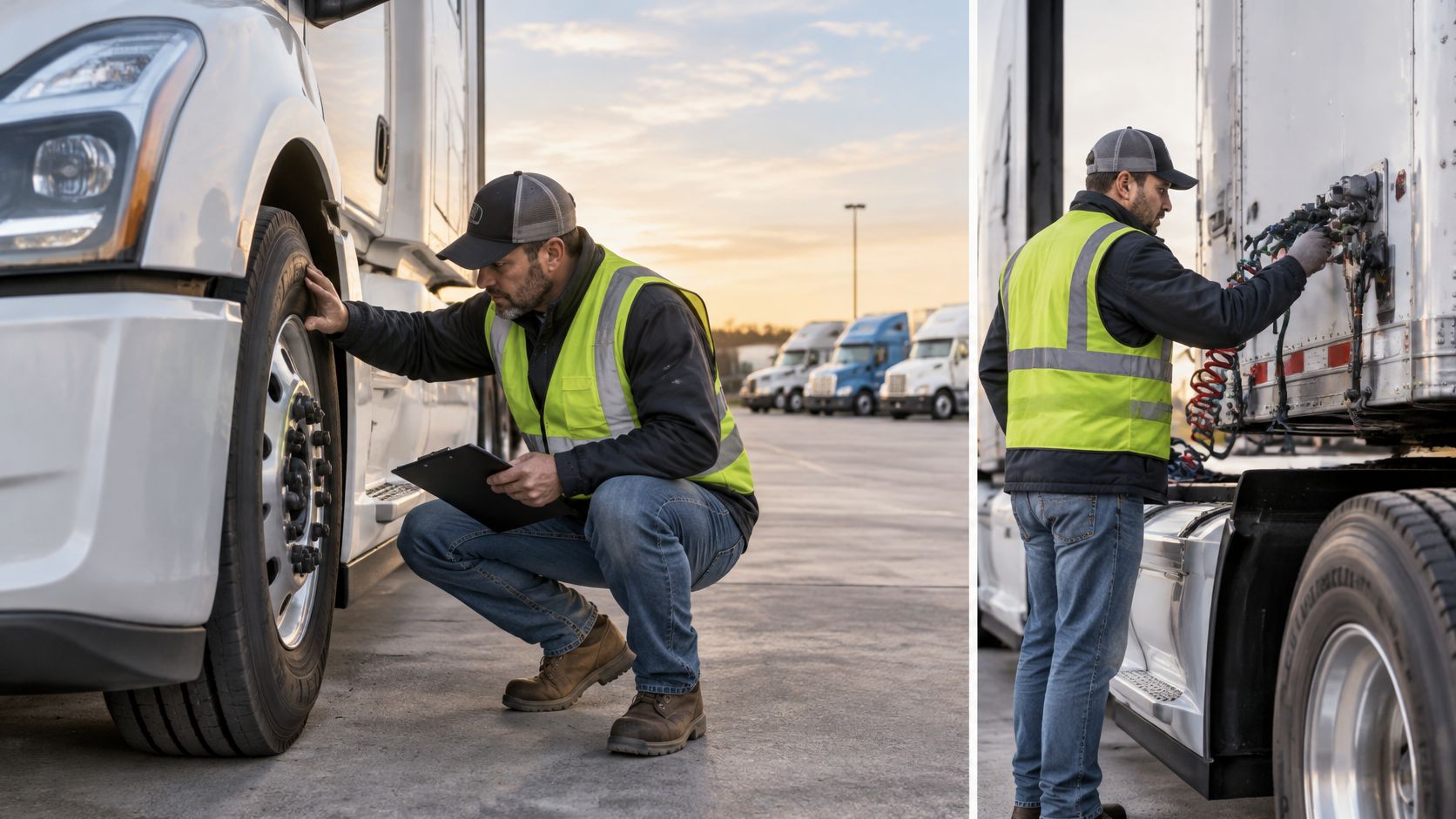
Structure your explanation around your actual routine:
- Before your walk-around: Review available defect information and confirm the status of reported repairs.
- Around your equipment: Explain your checks of tires, wheels, lights, lines, connections, and visible damage.
- Before movement: Describe your brake checks and coupling checks using your training and equipment procedures.
- When something's wrong: Explain your documentation, maintenance contact, and escalation process.
For intermodal work, include container seating, twist locks, and chassis locking components in your explanation. Describe only the equipment you understand.
If you find a damaged air line while an appointment is approaching, explain how you report it and get direction before moving. Your departure deadline doesn't replace your inspection decision.
5. How do you keep track of your hours of service, and how do you handle fatigue?
Recruiters ask this to learn whether you plan your day or let the clock plan it for you. Know the rules cold, then show how you build your schedule around them. Under the FMCSA property-carrying hours-of-service summary, you may drive up to 11 hours after 10 consecutive hours off duty, cannot drive beyond the 14th consecutive hour after coming on duty, need a 30-minute interruption after 8 cumulative hours of driving, and are limited to 60 on-duty hours in 7 consecutive days or 70 in 8, with a 34-hour restart available.
Explain your decisions, not just your display
Anyone can read an ELD screen. Carriers want to hear the thinking behind it. Describe how you check available hours before accepting a plan, account for loading delays, identify parking before you need it, and flag appointment conflicts early. Name the electronic logging system you've used and explain how you report an error on it.
Give a real example. If a receiver delay leaves you short on legal time for the next stop, explain when you notified dispatch and how you requested a revised plan. Committing to an impossible appointment tells the interviewer you'll run tired or run illegal.
Legal hours and alertness are separate checks. If you're fatigued, explain how you stop safely and notify dispatch.
For home-daily work, describe your sleep routine and commute. Ask about rotating start times and split schedules instead of assuming a local job guarantees predictable rest.

6. How do you handle a skid, a sudden stop, or a near miss on the road?
Lead with hazard prevention and controlled decisions. Explain how you adjust your speed, maintain space, watch changing traffic, and identify a safe way out before a situation becomes urgent.
Use an event you can describe accurately. If you haven't experienced a skid, say that and explain your training instead of inventing an emergency recovery story.
Walk through a real decision
For a merge-related near miss, describe what you noticed before the vehicle entered your lane. Explain how your existing space and speed allowed you to respond, then identify what you reviewed afterward.
- Before the hazard: Describe your visibility, traffic position, road conditions, and following space.
- During the event: Explain your actual response without exaggerating your control.
- Afterward: Describe reporting, checking your equipment when appropriate, and reviewing what you could improve.
If you've trained in the Smith System, you can connect your answer to its familiar principles: aim high in steering, get the big picture, keep your eyes moving, leave yourself an out, and make sure others see you. Use the framework to explain habits you practice, not as a substitute for an example.
For skid questions, follow your equipment-specific training. Avoid presenting a single steering or braking maneuver as the correct response to every loss-of-control situation.
7. How comfortable are you backing, docking, and maneuvering in tight yards or terminals?
Explain your limits as clearly as your skills. You sound more dependable when you describe checking clearance and repositioning than when you claim you can fit anywhere.
Walk through your setup, mirror checks, trailer path, and stopping points. Include how you get out and look, how you use a spotter, and what you do if you lose sight of that person.
For a hypothetical crowded receiving yard, explain how you would inspect the approach before committing to the dock. Describe identifying fixed obstacles, watching trailer swing, and asking facility staff about a safer setup when necessary.
A pull-up is a normal adjustment. Explain how you recognize a poor setup and correct it before contact occurs.
If you're newer, distinguish controlled-lot practice from live customer-site experience. Ask whether your orientation includes backing assessment and supervised facility familiarization.
- For terminal work: Discuss designated lanes, equipment movement, and gate instructions.
- For home-daily work: Ask which customer locations involve the tightest approaches.
- For unfamiliar facilities: Explain how you obtain instructions before entering a restricted or congested area.
Use these questions before accepting a local trucking job to check whether the advertised route matches the yard work you will perform. Ask about customer-site training, not just the road test.
8. Which endorsements and credentials do you hold, and are you ready for port or secure-area work?
Give your CDL class, exact endorsements, credential status, and expiration dates from your documents. If something is pending, call it pending.
Keep your endorsement codes accurate. H identifies hazardous materials, N identifies tank vehicles, T identifies doubles/triples, and X combines tank vehicles and hazardous materials. A hazardous-materials endorsement also involves a TSA security threat assessment.
Separate your credentials from terminal access
Your TWIC doesn't answer every access question. Confirm the carrier's registration responsibilities, facility systems, equipment instructions, and gate procedures before assuming you're ready for an assignment.
For Baltimore work, Maryland Port Administration's TWIC regulations require you to display a TWIC for unescorted access, with company and individual registration through eModal and Trucker Check. For Houston work, ask the recruiter to confirm Port Houston's TWIC, carrier-code, Lynx registration, and gate-transaction arrangements.
- Bring your documents: Have your CDL, medical certificate, and TWIC available when requested through an appropriate hiring channel.
- Track renewals: Use actual expiration dates rather than saying everything is current.
- Ask about costs: Confirm whether TWIC enrollment or renewal is reimbursed.
- Confirm facility rules: Ask which terminals your assignment uses and what orientation they require.
For example, if you're applying for Savannah intermodal work with a pending TWIC application, explain that status and ask how it affects training and your possible start date.
9. How do you check and secure cargo, and how do you handle weight and load documents?
Explain what you can inspect, what your equipment requires, and how you handle a discrepancy. Your answer should match your freight experience, whether that's sealed containers, palletized dry goods, or open-deck loads.
You can identify 49 CFR Part 393, Subpart I, and 49 CFR 392.9 as cargo-securement and inspection references without pretending every load has the same procedure. Explain how you follow applicable requirements, your training, and carrier instructions for the actual assignment.
Connect your checks to your paperwork
For an intermodal example, describe comparing the container and seal identifiers with the load documents, checking visible condition, and confirming the locking components before departure. If an identifier doesn't match, explain how you document the discrepancy and contact dispatch before proceeding.
- For accessible cargo: Describe the securement equipment you're trained to inspect and use.
- For sealed freight: Explain your external checks and discrepancy-reporting process without claiming you open every load.
- For weight concerns: Describe how you obtain weight information, check axle distribution, and request correction.
- For documentation: Explain how you handle bills of lading, seal records, damage notes, and delivery receipts.
If you're an owner-operator, clarify who supplies securement equipment and who authorizes load corrections. If you're newer, ask for equipment-specific instruction rather than claiming flatbed or container knowledge you haven't developed.
10. How do you communicate with dispatch when delays happen, such as detention or a late appointment?
Send an update when you identify the problem, not after your appointment has passed. Give dispatch your location, verified delay, appointment risk, available hours, and next action needed.
For example, if your freight isn't ready after check-in, confirm the facility's current estimate. Document your arrival, update dispatch through the approved channel, and explain whether the wait threatens your next appointment or legal driving plan.
Make detention and home time part of the conversation
Don't assume waiting time automatically becomes paid detention. Ask the recruiter to explain the written policy and the evidence you must submit.
- Pay trigger: What starts the detention clock, and what waiting period applies?
- Required proof: Do you need gate records, signed timestamps, messages, or another document?
- Submission process: Who receives your records, and how do you confirm payment?
- Schedule protection: What happens when terminal delays threaten your advertised home time?
For home-daily work, ask about the latest dispatch time and how unfinished assignments are handled. For port or intermodal work, ask who resolves chassis problems, terminal holds, and appointment changes.
Keep your communication short and factual. A useful update identifies what happened, what you've verified, and what decision you need. You can be firm about safety and hours without arguing with dispatch or facility staff.
10 Truck Driver Interview Questions Comparison Guide
| Interview question | Preparation complexity | Information or resources needed | What the interviewer assesses | Most relevant roles | Key advantage of a strong answer |
|---|---|---|---|---|---|
| Driving experience and equipment operated | Low | Work history, equipment types, weekly miles, regions | Experience and fit for freight, lanes, and trailers | All driving roles; especially intermodal or specialized freight | Helps match experience to the job accurately |
| Three-year work history, including gaps | Moderate | Employer names, dates, contacts, and factual gap explanations | Timeline consistency and reliability | All applicants | Builds trust and supports background checks |
| Safety record over the last three years | Moderate | MVR, PSP report, Clearinghouse record, incident details | Disclosure, safety awareness, and accountability | All commercial driving roles | Shows readiness to discuss verified safety history |
| Pre-trip inspection process | Moderate | Inspection sequence, DVIR knowledge, defect-reporting steps | Thoroughness and compliance with inspection requirements | All driving roles; especially equipment-intensive work | Demonstrates a repeatable safety routine |
| Hours of service and fatigue management | Moderate | HOS limits, ELD familiarity, rest and break plan | Legal compliance and sound fatigue decisions | Local, regional, and long-haul roles | Shows the driver plans safely rather than pushing limits |
| Skid, sudden stop, or near-miss response | Moderate | Defensive-driving practices and incident examples | Hazard awareness, control, and learning from events | All driving roles, especially highway work | Demonstrates calm, preventive decision-making |
| Backing, docking, and tight-yard maneuvering | Moderate | Backing experience, spotter practices, terminal familiarity | Low-speed control and awareness of people and equipment | Local, port, and intermodal roles | Shows safe maneuvering and willingness to reposition |
| Endorsements, credentials, and secure-area readiness | Low to moderate | CDL, endorsements, TWIC, medical certificate, expiration dates | Credential validity and eligibility for the work | Hazmat, tanker, port, and secure-terminal roles | Confirms job eligibility and identifies credential gaps |
| Cargo securement, weight, and load documents | Moderate | Securement procedures, weight checks, bills of lading, seal records | Load safety, legal awareness, and documentation habits | Flatbed, container, and general freight roles | Reduces cargo, compliance, and paperwork risks |
| Dispatch communication during delays | Low to moderate | ETA update approach, time records, detention policy | Timely communication and documentation | Local, regional, port, and appointment-based work | Helps manage schedule changes and support detention claims |
Frequently Asked Questions About Truck Driver Interviews
What questions should you expect in a trucking interview?
Prepare for questions about your equipment experience, employment history, safety record, inspections, hours of service, backing, credentials, cargo, and dispatch communication. Match your examples to the advertised route and equipment.
What should you bring to your interview?
Bring the documents your recruiter requests, plus an organized employment timeline and your questions about the job. Have your CDL, medical-certification information, and relevant credentials available.
How should you answer if you have limited experience?
Describe your training, supervised work, equipment practice, and current limits accurately. Ask about orientation, mentoring, and the skills you'll need to demonstrate before assignment.
How do you explain an accident or violation?
State what happened, identify the documented outcome, and explain your corrective action. Keep your account consistent with your application and available records.
What should you ask about a home-daily position?
Ask about start times, the latest dispatch, your home terminal, weekend expectations, and delayed-load procedures. Confirm whether home daily describes the intended schedule or an unconditional commitment.
Can you interview before receiving your TWIC?
Tell the recruiter your actual application status and ask whether you can proceed. Your carrier and assigned facilities determine when the credential is needed for the work.
Does a successful interview mean you're hired?
Treat the interview as part of qualification, not a final hiring decision. FMCSA's qualification checklist includes a signed application, employment investigation, licensing-record checks, and medical qualification.
Turn Your Answers Into a Stronger Job Search
Your preparation should produce a consistent account of your experience, records, and job preferences. Review your documents, choose real examples, and practice explaining your decisions without memorizing a script. You should be able to describe what happened, what you did, and what you learned.
Use the interview to evaluate the carrier just as carefully. A clear explanation of your safety habits deserves equally clear answers about dispatch expectations, maintenance support, compensation, and home time. Ask who can confirm an unanswered detail and get important offer terms in writing.
Compare the actual assignment
- Schedule and home time: Confirm your dispatch window, reporting location, weekend obligations, and handling of delayed loads.
- Pay and benefits: Review the pay basis, accessorial compensation, eligibility conditions, deductions, and benefit start conditions.
- Equipment and support: Ask about equipment assignment, maintenance reporting, roadside support, and replacement arrangements.
- Qualification and training: Confirm required credentials, experience standards, road testing, and equipment-specific orientation.
Search by the work you want rather than accepting the broadest available description. Use terms such as home-daily CDL jobs in Savannah, Houston intermodal trucking jobs, or local Class A jobs in Atlanta to narrow your search, then verify each listing's details. Apply the same approach when comparing opportunities around Compton, Baltimore, Myton, Grand Rapids, or elsewhere nationwide.
Your interview answers should also help you reject a poor fit. If your priority is a dependable home schedule, don't overlook vague answers about late dispatches. If you need container training, confirm that support before agreeing to an intermodal assignment.
Find New Drivers supports your search for local, home-daily, regional, intermodal, and over-the-road opportunities with participating carriers. You can use location and route preferences to focus your search, review available job details, and prepare carrier-specific applications. Each carrier makes its own hiring decisions and sets its own requirements, so verify availability and qualifications before treating a listing as an offer.
Find New Drivers helps you compare trucking opportunities by location and route type, then connect with participating carriers. Visit Find New Drivers to look for work that fits your experience and home-time priorities, and use these interview questions to prepare before contacting a recruiter.